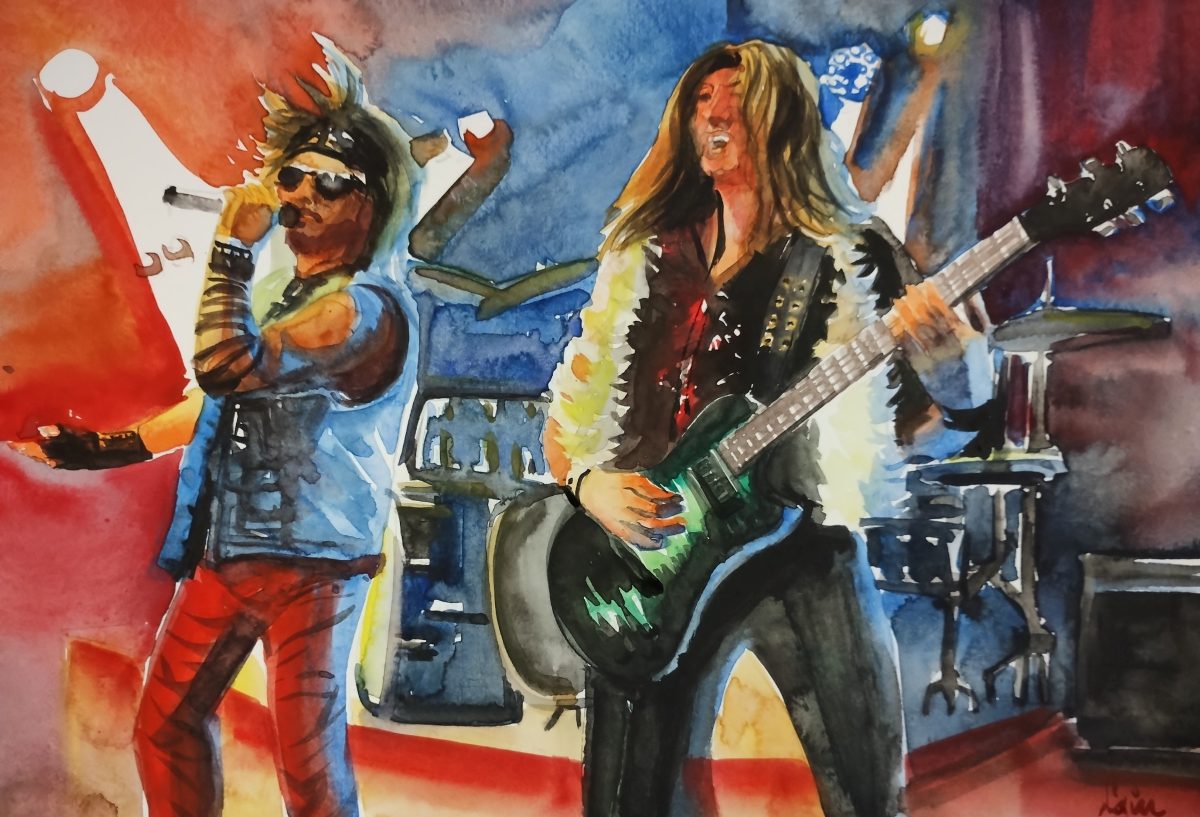
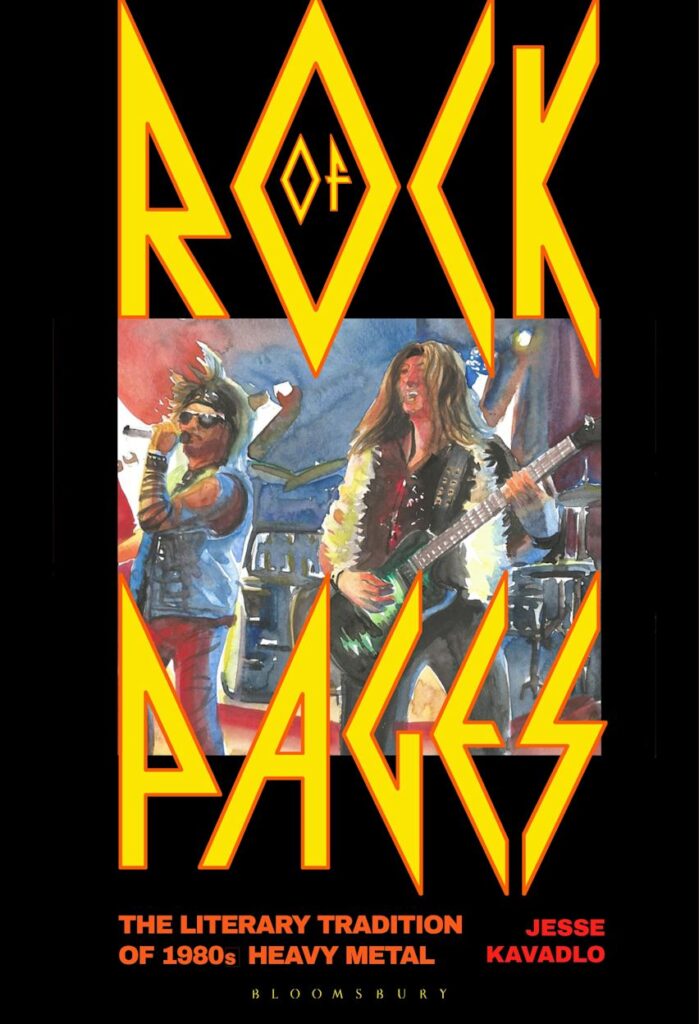
Rock of Pages: The Literary Tradition of 1980s Heavy Metal by Jesse Kavadlo does for rock and heavy metal music what literary theorists do for literature. One needn’t be a novelist to analyse novels, being a littérateur is enough. But Kavadlo goes the extra mile. His deft analyses of lyrical themes in the work of important rock acts of the 1980s and the cultural moment they occupy are informed by his professional bona fides as a rock musician—playing with the band Top Gunz—and as a professor of English and Humanities at Maryville University of St. Louis.
Kavadlo has written on and taught the work of Michael Chabon, Chuck Palahniuk, and Don DeLillo. In 2022 he was editor on a book of essays on the work of Don DeLillo put out by Cambridge University Press. He has written extensively about music, especially 1980s rock and heavy metal; pop culture, including superhero comics and films from the 1970s-1990s in various fora.
In an academic treatment of any media form there is the risk of rendering tedious and inanimate what is interesting and vital. This is never the case here as you’d expect from someone who teaches very obviously fun courses like Aliens to Zombies: Monsters in Literature and Film, Reading Rock & Roll, and Superheroes in American Culture.
Here’s an interview with Jesse Kavadlo on his latest book, the culture of critique, and the fate and promise of music and the arts in our time and beyond.
MIDDLEBROWSE: Heavy metal is often typecast as dumb music made by and for dumb people. It is criticised for its lyrical themes, and even if it is not criticised no one tends to go to heavy metal music to experience poetic or literary transports.
For me as a listener, and perhaps for many others, the immediate and visceral appeal of heavy music lies in its musical, specifically non-lyrical, content. While a lot of my favourite heavy music has very good lyrical content, counterfactually I can imagine that Metallica’s …And Justice for All would be just as compelling and influential if the lyrics were other than they are. Had Hetfield just growled garbled nonsense in roughly the same rhythmic and melodic arrangement, the songs I think would land just as well as they do now.
Why do you think then that criticisms of heavy music seem to target the lyrics specifically as the bad-making factor?
Do you think the PMRC’s criticisms of the “filthy fifteen” for lyrical themes of smut and sadism would have been made anyway if the lyrics were tamer, or something highly imaginative like SciFi fantasy?
I feel there would still be criticisms, but they would target the public persona and videos, or perhaps they would target the shocking, abrasive, and intense nature of the music itself compared with easy-listening radio playlist music. Tipper Gore listening to a version of The Shortest Straw with Hetfield performing variant lyrics made up of inarticulate grunts would probably still think he was saying more than what would be proper to say, let alone sing about.
JESSE KAVADLO: “These are valid points—including the possibility that some lyrics are simply unintelligible (think Weird Al’s parody of “Smells Like Teen Spirit”; much of AC/DC’s catalogue) or that some fans claim not to listen to the lyrics much at all, favoring the beat or, as people say now, the vibes.
Part of the book’s focus on lyrics is because, well, it’s a book, and you can’t get the sound from a story in a magazine, as Billy Joel sang. I got to write words about words, as opposed to words about sounds, recalling the apocryphal quotation from Frank Zappa or maybe Elvis Costello that “writing about music is like dancing about architecture.” Of course, that’s suspect anyway—humans attempt to put words to wordless experiences all the time. Love! Colors! God! And, of course, music. Putting words to wordless experiences is what words are for! And it turns out there have been several dances about architecture!
But seriously, I do feel as though my understanding of the songs is richer by paying close attention to the lyrics. And for me, good lyrics reward repeated listening in a way that inarticulate grunts might not, even if the first few spins still sound good.
At the same time, a good deal of rock lyrics, from Little Richard through Bon Jovi, to say nothing of, say, modern extreme metal, have had their fair share of excellent vocal nonsense! NPR critic Ann Powers has analyzed how the nonsense lyrics of 1950s rock and roll put a human voice to inarticulate, often sexually confused yearnings, something that I think doo wop, amazingly, shares with death metal. And “Louie Louie,” foreshadowing “Smells Like Teen Spirit” as a song mainly remembered for its impossible-to-understand lyrics, was controversial in its day because parents accused its very unintelligibility of concealing obscenity!
Interestingly, David Byrne has discussed how some of the Talking Heads’ lyrics developed from vocal sounds and utterances that best fit the music! Sounds first, words second.
That said, during the PMRC hearings themselves, which were supposed to be about parental warnings for lyrical content on albums, PMRC founders Tipper Gore and Susan Baker, plus Senator Paula Hawkins, in addition other surrogates in the Senate who were married to PMRC members—Al Gore, Ernest Hollings, and John Danforth—made sure to share album covers (by WASP, Def Leppard, and Wendy O. Williams) and music videos (Van Halen’s “Hot for Teacher” and Twisted Sister’s “We’re Not Gonna Take It”) on the Senate floor. This to me suggests that their criticisms of the lyrics were just a part of their overall crackdown on heavy metal itself, its fans, and all its cultural practices, from lyrics to imagery to performance to videos. Lyrics were an easy first target because individual lines could be taken out of context, as Dee Snider pointed out, or because many of them used an “I” persona typical for poetry and fiction, which the PMRC refused to acknowledge.”
MIDDLEBROWSE: Why do you think heavy music makes certain censorious audiences more anxious than say aggressive electronic or dance music that often comes paired with suggestive lyrics and sexual imagery?
JESSE KAVADLO: “The five non-metal songs in the PMRC’s “Filthy Fifteen,” left out of my book, deserve their own analysis, because they seemed to make the PMRC upset for different reasons. Consider Prince’s “Darling Nikki,” Sheena Easton’s “Sugar Walls,” Vanity’s “Strap On ‘Robbie Baby,’” Madonna’s “Dress You Up,” Mary Jane Girls’ “In My House,” and Cyndi Lauper’s “She Bop.” All were deemed objectionable for being sexually explicit (and a subcategory, for talking about masturbation). No violence, no drugs or alcohol, no occult. All are women singers or groups, except for Prince, who, like metal bands, cultivated androgyny; unlike most metal bands, he was Black. This is all to say: censors were certainly worked up by the metal bands—9 of the 15 songs were metal. But not exclusively. Women and the one male of color also got under their skin, too, specifically by singing about sex.
The other point I’d make is that most of these groups were very popular, making them ripe targets, unlike, say, electronic music, which, as far as I understand, was underground in the US until the 1990s, at which point the PMRC had won the battle (stickers on lyrics) but lost the war (the culture overall didn’t support them and seemed just fine with sexual lyrics; more on that in a minute). WASP was not yet famous but were up and coming, and the “Animal” import single cover was too good a prop for the PMRC to ignore. Only Mercyful Fate and Venom were not mainstream or even especially popular in America. They were, frankly, odd choices that suggest to me that the PMRC didn’t have much to work with for the occult category but wanted to include it to rally followers of the popular 1980s televangelists who were preaching against metal as well.”
MIDDLEBROWSE: You correctly point out authors have been writing about sex, violence, and intoxication for hundreds if not thousands of years. These themes only seem to become controversial when they arise in heavy music. One doesn’t think Tipper Gore would recommend that Aeschylus’ Oresteia be taken off literature syllabi because it revels in murder, incest, and revenge. Why do you think literature gets a pass but music with the same themes elicits such vehement criticism? Is music seen as more frivolous and so less consequential than literature? That cuts both ways; it would be strange to get worked up about something frivolous and inconsequential.
JESSE KAVADLO: “The Beatles and Bob Dylan were taken seriously as artists during their own time. Many musical forms once thought of as dangerous—rap—or inconsequential—pop—have since received academic attention (say, Taylor Swift) and literary awards (Kendrick Lamar). It seemed to me as though only much of 1980s heavy metal was still thought of as music for dummies, by dummies. Other music and art forms were given enough credit that their creators, texts, and audiences could see the value and merit that went hand in hand with potentially objectionable violent or sexual content. Heavy metal got the same misrepresentation that both pop and rap initially did, yet critics of both genres eventually came around (or shut up)—for rap, critics could not separate artistic persona from real person; for pop, critics implied that popularity meant superficiality and ephemerality. Because of the images and personas they cultivated, heavy metal was taken entirely literally and therefore was dangerous, like rap, but also as entirely shallow, like pop, the worst of both criticisms.
Since 2021, book challenges in America have reached unprecedented levels. Literature is being pulled from the libraries and curricula of high schools for the same reasons that the PMRC objected to metal—mainly for sexual content, but also violence, occasionally the occult, and even a new category: a focus on race and/or anti-American viewpoints. The exact opposite of what I’d hoped is happening. I wanted heavy metal to be treated more like literature: worthy of analysis, accessible. Now, literature is being treated more like heavy metal, and not in a good way: objectionable, censored, rendered inaccessible to teens.”
MIDDLEBROWSE: In your interview with Mike Consul, you pointed out a handful of people are responsible for the vast majority of calls for books to be banned. Which books attract that sort of ire also seems to be a somewhat arbitrary matter; no one is calling for a ban on the works of Shakespeare. Do you think there is an element of classism, or snobbery, involved? Is heavy metal preemptively coded as a demotic, low class, art form more given to indecency compared to classical music or high literature? Why do you think this might be?
JESSE KAVADLO: “In the 1980s, I would say that bias against lower- and working-class fans and artists was a strong factor against metal, just as it was during Payola in the 1960s towards rock & roll and Country music fans. While in the UK, punk seemed to be a bastion of the working class, in New York, where I was growing up, many punk fans seemed well off, and fandom was a conventional route to teenage rebellion more than class consciousness. This is an anecdote, of course, but overall, when it came to critics and even academics, punk was cool and heavy metal wasn’t—at least among that certain and specific elite. I and millions of others certainly thought metal was cool.
While in the 1990s you’d still see challenges against classics like Of Mice and Men and Catcher in the Rye, many of today’s book bans in the US are targeting what the censors perceive as racial and LGBTQ themes and content. Heavy metal in the ‘80s again had a class-aware, as opposed to a racial, angle—think of the video for “Nothin’ But a Good Time”—but there is certainly overlap in terms of sexuality. As I suggest in my book, Tipper Gore’s very first targets in her first editorial, before the hearings or her book, were Judas Priest, Twisted Sister, and Motley Crue. While Priest singer Rob Halford was not yet out of the closet, all three groups were certainly playing with images and attitudes regarding gender: masculinity, femininity, androgyny. When Gore wrote, in that op-ed, that “‘sadomasochism, bondage, incest, and rape are out of the closet and into the lyrics,’” as I wrote in the book, “out of the closet’ meant exactly what it sounded like. (Something not in the book: Gore never had any actual examples—not a single one—in any of the “Filthy Fifteen” for any of those topics!)
Even then, though, the threats to major authors are coming from different places now. Conservatives in the 1980s—think Allan Bloom—wanted more Western Canon and less identity-based reading. While it’s not widespread, today, even Shakespeare isn’t immune—in 2023, some Florida schools pulled Romeo and Juliet for sexual themes.
The number of books in states like Florida and Texas—and my home state, Missouri—being challenged has led to what I think of as soft censorship, maybe second-hand censorship—not the headlines and pomp of the PMRC hearings, but quiet, lowkey decisions by school districts and teachers simply not to include any potentially objectionable books in the curriculum to avoid potential complaints and skirt the issue entirely. At the same time, possibly relatedly but also to teach to standardized tests and in response to dwindling attention spans, full-length books simply aren’t taught as often in high school now, in favor of short works and excerpts. It’s not what we think of as overt censorship, but it’s a kind of de facto censorship, limiting what students read during their formative years and concerning for anyone who cares about literature and books.”
MIDDLEBROWSE: Not all music with problematic lyrics gets called out by censorious critics. You’ve pointed out how explicit lyrics in songs by big acts like Nine Inch Nails and Nickelback were not only not criticised but were also celebrated. What kind of dynamic might be at play here? Do you think there’s a pattern in what kind of cultural artifact raises hackles and what kind meets approval or gets a pass? Is there a formula for repeating the success of NIN or Nickelback while putting out scandalous lyrics that bypass the censors?
JESSE KAVADLO: “Here, mainly, I think what happened was this: Tipper Gore won the battle (the labels went on the records, if sans specific content warnings) but lost the war. By as early as 1994, Nine Inch Nails’ “Closer,” with its lyrics so similar to WASP’s “Animal” a decade earlier, was released to great acclaim and no senate hearings whatsoever. There was no longer any political clout to fearmongering over music lyrics. Al Gore had been jockeying for a Presidential run, but he lost the nomination twice before winning the election as former rival Bill Clinton’s running mate. Clinton himself had criticized rapper Sister Soulja during his own campaign in 1992, a calculated move to appeal to centrists and conservatives that in the end received more backlash than praise. Metal, although not as popular or mainstream at this point, arguably got more extreme after the 1980s, but to less public criticism than the relatively benign “We’re Not Gonna Take It.” By the 1990s, then, the PMRC hearings were held against Gore, exactly the opposite of what he and Tipper had hoped. The formula for success vs pushback might be as simple as being in the right place at the right time, the cultural context.”
MIDDLEBROWSE: Occult themes in heavy music have often drawn criticism from religious critics and audiences. You’ve pointed out before that a lot of such criticism comes from parents concerned about what media their children have access to. But commentators like Ross Douthat at the New York Times have observed that it is increasingly common for bookstores to be well-stocked with books on Tarot, Wicca, palmistry, astrology, and astral projection. Taking a Tarot reading has been assimilated into the mainstream to the point where it is no more noteworthy than getting a massage.
There is also a shift in Western religious attitudes where even as the number of people who identify as atheists has gone up, there is rising interest in alternative spiritual practices and belief systems among their ranks.
Do you see people making distinctions between the safe and sanitised varieties of the occult on one hand and dangerous and morally problematic ones on the other, reiterating in a new mode the high-versus-low culture divide evinced in genres of literature and music?
JESSE KAVADLO: “You’re right that what would have been fringe practices in the 1980s are mainstream today. This shift might be Exhibit B on how the PMRC lost the war. A show like Stranger Things—one of the touchstones of my book—features actual monsters and the supernatural and yet also provides social commentary on the wrongheadedness of the 1980s satanic panic.
There are still recent satanic accusations, though, if a little absurd now. Lil Nas X got significant opprobrium from religious groups for “MONTERO (Call Me By Your Name)” in 2023 for its video’s religious and satanic imagery. But, of course, as I suggested about the imagery in the 1980s, the imagery was much more, in this case, overt homoeroticism. Satan again serves as a proxy and metaphor for rebellion, in this case of a particular, sexual kind. Even Ghost, a band that, like Venom in the ‘80s, relishes satanic iconography for its entertainment value, was blamed for “cursing” the Orlando Magic following a 2026 concert in the Kia Center. It’s likely a joke, but a revealing one, as jokes tend to be.
More seriously, QAnon, the far-right conspiracy theory, invented claims of an elite cabal of Satanic, cannibalistic child molesters. Amazingly, they seem to have been right about the child molester part! But that they accused specific Democrats of being Satanists first shows the continuing power of devilish epithets and accusations. If anything, the actual Church of Satan actually seems pretty chill.”
MIDDLEBROWSE: You started out playing bass guitar, and jazz specifically. Bass is not the first instrument a young person is typically drawn to, and jazz has not been popular or even countercultural music for a very long time now. How did this choice of instrument and genre come about? Was it an influence of the music you were exposed to at home? Also, who are some of your favourite bassists in jazz and heavy metal?
JESSE KAVADLO: “I was given string bass in elementary school orchestra, pre-metal, and that random assignment arguably affected my entire life. I loved playing the bass when I was starting out. I went on to play bass—an in-demand instrument from teachers’ and band leaders’ point of view—in my Junior High and High School jazz bands as well as our extracurricular Sing band. For me, in those songs, the bass was audible and crucial in a way that the guitar just wasn’t. Muscular, central. By age 13, I also loved the bass because of one band, my favorite at the time: Iron Maiden. Steve Harris wrote Maiden’s songs on and around the bass. The bass was louder than the guitars, locked in with the drums, and it sounded fantastic.
I still play a half-dozen or so bass gigs every year, but at weddings! There, many of the songs are Motown (James Jamerson!), funk (Larry Graham!), and pop, like Michael Jackson and Bruno Mars, where the bass still rules, and the guitar, as much as I love Nile Rodgers, mainly strums a “plinky plink” chord every bar or so and all the solos are cut from the wedding setlist mashups. The guitar is central to rock and metal, but the bass is the center of these other genres.”
MIDDLEBROWSE: On the Shipp Show interview, you spoke about “the magic of the live show which is not just about what happens on stage” and how “the audience is crucial; standing, chanting, singing along.” Rock and metal seem to differ from classical music in their encouragement of audience participation in, and indeed full-bodied expression of enthusiasm for the music.
These are different cultures, with differing sensibilities about what the appropriate mode of aesthetic engagement is. Being a patron of heavy music calls for adopting a different attitude towards the musical experience than does being a fan of classical music. There’s a high versus low culture dialectic in motion between these genres, with the classical music performance demanding proper form and decorum from the live audience and the live heavy metal gig freeing the audience to come as they are, and express their authentic, spontaneous response to the musical material.
Do you think dance music is more allied to heavy metal in its openness to authentic, spontaneous, and disinhibited audience response especially when compared to classical music?
JESSE KAVADLO: “One thing I didn’t get to write or talk about but that I find endlessly amazing is that rock show audience participation is arguably derived from the Gospel music experience of choirs and call and response, which of course comes from the American Black church. Gospel, dance, and heavy metal seem to me to be rooted in the body and spirit in a way that classical, with the occasional historical anomaly of, say, Niccolò Paganini (a shredder!) is not. Gospel, dance, and metal encourage participation, movement, vocalization, and ecstasy, rather than the word I most associate with classical: appreciation.
Now that I play 1980s hairband hits in my tribute band every weekend, I can see just how much groups like Van Halen, Def Leppard, Poison, Bon Jovi, and even Motley Crue are, at bottom, dance bands. People love to move to the fast songs and slow-dance to the ballads. Once in a while, we’ll play a song that’s not quite danceable but that we think people will love anyway. Most of the time, we learn that we need to stick to songs that make people move on the floor, or they will move to the bar.”
MIDDLEBROWSE: You hit the nail on the head when you pointed out that if heavy metal or rock audiences responded to a live rock performance the way someone at a classical recital does it would show that that was “a very dull concert.”
Do you think that all things being equal audiences themselves make and police the norms of what’s appropriate at a live performance or, do musical genres come with their own prescriptions for appropriate aesthetic engagement and audiences simply comply in order to retain access to the genre community?
JESSE KAVADLO: “I’m going with the way you put it, that yes, “musical genres come with their own prescriptions for appropriate aesthetic engagement and audiences simply comply in order to retain access to the genre community.” It’s what David Shumway referred to as “cultural practices of rock music,” except you can put in whatever genre you want; it’s why arguably the first academic book about heavy metal, by Deena Weinstein, needed to be a work of sociology. Hair? Clothes? Attitudes? Concert behavior? Instruments—including brands—and instrumentation? Even which particular drinks, which particular drugs? All connected to, derived from, genre. For me and fans in the 1980s, this was mostly intuitive, although not unconscious. The way to be a part of the rock community was simply to love the music and then look and act the part. Of course, there was some policing, accusations of being a poseur, but the harassment that came with the long hair and denim and leather, and the hours put in to learning an instrument and band rehearsal, were hallmarks of dedication and authenticity.”
MIDDLEBROWSE: You’ve claimed that rock is a genre that calls for restraint and self-control. As a working professor and rock musician you embody those ideals. You are a very disciplined writer putting in the same amount of time writing and producing at least a set number of words every day. You also maintain a punishing performance schedule with four-hour gigs and no chairs on the stage like at some classical recitals.
Lots of people are drawn to the guitar by the apparent effortlessness it seems to promise, and most of them give up before they can play a few campfire chords. The guitar is an instrument that enjoys the reputation of being easy to learn and difficult to master.
Did you always see discipline as a key part of rock music performance, or were you initially drawn to the aura of effortless charisma that a competent rock musician exudes? Were there moments of disillusionment where it seemed you were not getting better on the instrument? How did you power through?
JESSE KAVADLO: “Quick change—in the book, I suggest, in contrast to Tipper Gore’s assertion, that rock is the genre least likely to exercise self-restraint! (Although I also contradict this by suggesting that the high/low cultural dynamics of literature vs rock don’t hold up to historical or even textual scrutiny. So there’s that.)
I do, though, again like the way you put this—”the aura of effortless charisma that a competent rock musician exudes.” Some artists, like James Brown, John Mellencamp, Tina Turner, or Bruce Springsteen, like to look like they’re working. That’s their image, their schtick. I prefer the Van Halen image of effortlessness, though, even though of course he and all the virtuosos who followed put in the time.
Speaking for myself, and maybe some of them if it fits, I did practice a lot in my teens—but it didn’t feel like work. I liked it. It was fun. That may be the main difference between people who stick with an instrument and people who can’t—if the playing is torturous, why do it? Find another instrument. Find something where the effort feels good, even if the fingers, and the ears, don’t, not at first.”
MIDDLEBROWSE: Why should someone who dislikes heavy music read your book? And where should people go to keep up to date with what you’re doing in music and literature?
JESSE KAVADLO: “I’d like to think that there are four groups of people who may read and enjoy the book: the first is obviously fans of the music—but not necessarily any or all ‘80s rock and metal fans. There are a lot of what many people would consider deep cut references and jokes, like the line about “Creeping Death” resembling the movie “The Ten Commandments” more than Exodus, maybe because Kirk Hammet left Exodus (rimshot). Fans who have listened to these bands, and maybe read some memoirs and history, and aren’t wondering what happened, but want to read about what it meant then, and what it means now.
The next group would be readers interested in any music and culture of the 1980s, if not this musical genre itself, or just readers who like musical analysis regardless of genre.
The third group would be readers, people interested in literature, coming at it from the other angle, and who appreciate good and unlikely comparisons and close readings.
The last group would be any reader who wants to read the connections of someone who is excited by the topic, who relishes cultural connections and insights regardless of the topic. For me, the book is meant to provide something that AI-generated writing, or even maybe any other person, can’t do. It is an intricate document of a person’s—my—thinking process and life’s journey, based on decades of experience reading, writing, teaching, and playing.
Find me on all social media—I’m the only person with my name—or visit my website: https://jessekavadlo.com/
Thank you!”